



The First Inhabitants of the Nicoya Peninsula
The Nicoya Peninsula, before there was a country of Costa Rica, had long been inhabited by Indigenous peoples, among them the now extinct Chorotega. By the time Spanish explorers reached Nicoya in the early sixteenth century, recently discovered burial grounds showed that it had already developed into an important and sophisticated population centre. Spanish accounts suggest an already developed culture with specialists and settled communities. Sadly, European contact also introduced epidemics, violence between settlers and natives (more like settlers throwing their weight around and the natives defending what was theirs) disease-based slavery/enslavement and enslavement with export of Indigenous peoples. From approximately 1529 to 1557, the Nicoyan population plummeted; estimates suggest around an 80 percent loss.
The Birth of Today’s Nicoya and the Way to Costa Rica
In the eighteenth century, however, the region was becoming something else. Settlers created farms and ranches as communities like Nicoya, Santa Cruz and present-day Liberia expanded in importance. The local economy grew more dependent on agriculture and livestock. Many of the community leaders who exerted an influence had come from families that first settled this area generations before. These local leaders got into municipal government, commerce, landholding, education, churches and community organization.
And then, one of the key moments in the region’s history took place.
The representatives of Nicoya met on July 25, 1824 in a cabildo abierto (open town council) under the leadership of Manuel Briceño. Though many fought for their unquestionable right to belong to Nicaragua, Nicoya and Santa Cruz opted instead for inclusion in Costa Rica. The infamous ruling went on to be associated with the slogan De la Patria por nuestra voluntad—”By Our Own Will of the Fatherland.”
Transforming Ranches And Farms Into Greater Communities
With the incorporation of the Nicoya Peninsula, a new economic age began. Agriculture and livestock became more important. The small farms grew, while cattle ranching proved especially profitable. They then imported large numbers of Nicaraguan cattle and fattened them for Central Valley markets in Costa Rica. Agricultural goods were transited both by land and over sea, making Puntarenas an increasingly important link.
As early as the nineteenth century, boats were transporting agricultural goods from the peninsula across the Gulf of Nicoya to Puntarenas. Outside of the towns, however, it remained largely rural.
Agriculture evolved finally into a combination of subsistence agriculture and market production. Local families depended on corn and beans for sustenance, while cattle ranching spread greatly.
Cóbano and the Southern Peninsula: The Crescendo of Development
The southern tip of the Nicoya Peninsula was hard to access for centuries. Cóbano, Paquera and Lepanto had been part of the Nicoya region decades earlier, but their administration with Nicoya was gradually misunderstood as sea transport from Puntarenas was more accessible than overland hours to Nicoya. In the early 1900s, Cóbano, Paquera and Lepanto were administratively incorporated into Puntarenas.
And Cóbano itself grew as an agricultural community. Transportation used boats, rivers and coastal routes for many generations. People and even goods—such as livestock, chickens, fruit, and grains—could be transported in small boats that locals supported with hand paddles called bongos. The industry really began to open up the region around 1958 with the construction of the Tambor pier and later ferry services.
Then came 1971, when Cóbano was made an official district of Puntarenas.
In those days Santa Teresa was still a small, secluded village.
The Story of Santa Teresa
Unlike the singular date of birth that many places can reference in their memory, for Santa Teresa its origins are heralded in local tales not specific benchmark prairie dates. Historic reports indicate that the land that now comprises Santa Teresa, was previously part of a farm known only as Finca El Carmen. Gerardo Reyes Reyes, one of the residents who has lived there for decades, remembered that the land was sold before people started moving in and subdividing it in the 1970s.
This area was one of the most remote places on earth for many years. Roads were terrible, there was no electricity, and ferry crossings of the Gulf of Nicoya were infrequent. Santa Teresa was different; it wasn’t yet the international tourist destination that we all know it as today. It was located instead in a region saturated by cattle ranches and rural plots.
The 1980s saw the arrival of electricity in the region, which established the foundation for developing the first hotels and resorts. Costa Rican tourism authorities note first hotels and resorts by Mal País began appearing in circa 1986 but Santa Teresa stayed off the radar for most international visitors.
The Tourism Revolution
Santa Teresa underwent rapid transformation at the end of twentieth and beginning of twenty-first centuries. The community was slowly transformed by improvements in transportation and electricity, better roads, international exposure and surfing culture that resulted in foreign
investment. Santa Teresa started drawing surfers, backpackers, entrepreneurs, and investors from all over the world during the 1990s but the biggest boom was seen in the early 2000s. Foreign investment market bought up property to help sell the area as a world class surfing destination.
The transformation was extraordinary.
Surf schools, restaurants, hotels, villas, cafés, shops and yoga studios started sprouting where ranches and sparsely populated farms once stood. Santa Teresa fused with Cóbano, where increasingly important tourist dollars were spent. According to the municipality, Cóbano had a population of around 9,736 by 2022: 7,494 in 2011.
But old Santa Teresa remains.
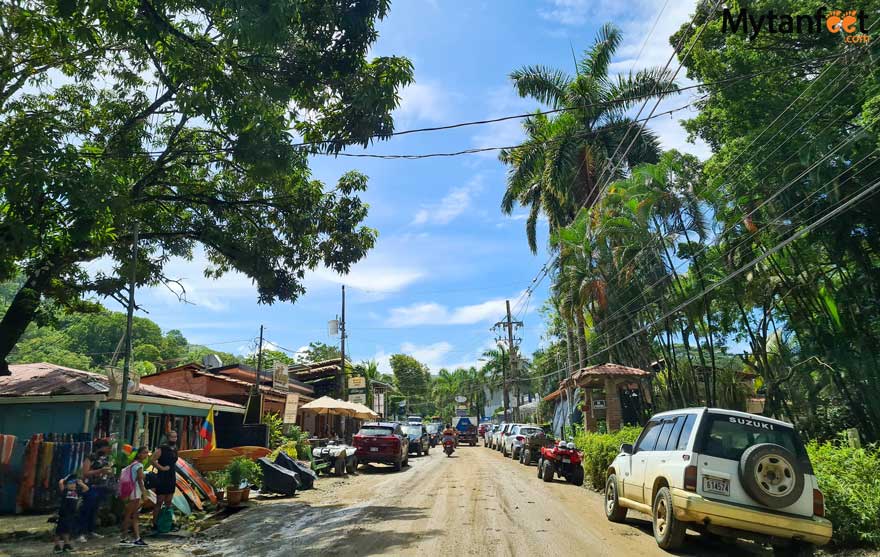
It’s evident in families whose roots run generations deep, the former cattle lands surrounded by tropical growth, former farmer roads now inundated with tourist vehicles and resilient traditions that hold a community together through great change. It is also visible in the animals and forests grown over protected fields. Cabo Blanco is a clear example of the idea that development and conservation can thrive together.